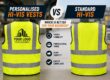
Yes, you can personalise hi-vis vests, but it has to be done carefully. Adding a company logo, staff role, department name, or site identification can make workwear look more professional and help teams stand out. However, high-visibility clothing is still PPE. That means branding must never reduce the garment’s safety performance.
In the UK, high-visibility clothing used as PPE should be suitable for the risk and manufactured to a recognised standard, with EN ISO 20471 setting requirements for visibility materials, garment design, and performance.
So, where is the line between safe personalisation and a compliance problem?
Let’s break it down.
What EN ISO 20471 Is Designed to Protect
EN ISO 20471 focuses on making the wearer visible in daylight and when illuminated by headlights in darker conditions. It does this through three key elements:
- Fluorescent background material
- Retroreflective tape
- Garment design and coverage
The standard also uses garment classes, with Class 1 offering the lowest visibility level and Class 3 offering the highest. These classes depend on the amount of visible fluorescent and reflective material used in the garment.
For a deeper explanation of colours and classifications, you can read: Hi Vis Colour Codes Explained (EN ISO 20471)
Where Personalisation Can Go Wrong
The main issue with personalised hi vis vests is not the logo itself. It is where and how the logo is applied.
Personalisation may affect compliance if it:
- Covers reflective tape
- Reduces the visible fluorescent background area
- Changes the garment structure
- Uses large printed panels across key visibility zones
- Makes the vest harder to identify from different angles
A small chest logo is usually less risky than a large back print, but every design should still be checked before production.
Printing vs Embroidery on Hi-Vis Vests
Both methods can be used, but each has different considerations.
Printing
A custom printed high visibility vest is often chosen for large logos, back text, staff roles, or event branding.
Printing works well when:
- The design is placed away from reflective tape
- The printed area does not dominate the fluorescent fabric
- The print method is suitable for the garment material
- Wash durability is considered
Embroidery
Embroidery can look smart, but it is not always the best choice for lightweight hi-vis vests.
It may create:
- Small holes in the fabric
- Extra stiffness
- Pulling around thin material
- Reduced comfort on lighter garments
For many vests, printing is often the more practical option, especially for larger designs.
What About Reflective Safety Vests?
A custom reflective safety vest must still perform as a safety garment first.
Reflective tape should remain clear, visible, and uninterrupted. It should not be printed over, stitched through unnecessarily, or covered by patches.
Reflective tape is especially important in low-light conditions because it reflects light back towards the source, such as vehicle headlights. If branding interferes with that function, the vest may no longer provide the expected level of protection.
Can a Personalised Vest Still Be Certified?
It depends.
If a vest is certified before customisation, that certification applies to the garment as originally tested. Once printing, embroidery, patches, or alterations are added, the supplier should ensure the decoration does not compromise the certified design.
This is why employers should avoid guessing.
Ask the supplier:
- Will the personalisation affect EN ISO 20471 compliance?
- Where can the logo be safely placed?
- Is the design suitable for the garment class?
- Will reflective tape remain fully visible?
- Will the vest still be appropriate for the work environment?
This is similar to repair decisions. Once the original garment is changed, compliance needs careful consideration. You may find this helpful:
The Safest Areas for Branding
Although each garment should be checked individually, safer branding areas often include:
- Small left chest logos
- Limited back text placed between reflective bands
- Name or role printing away from tape
- Simple designs that do not cover large fluorescent areas
Riskier areas include:
- Across reflective strips
- Over shoulder tape
- Large solid back panels
- Full-width printed blocks
- Heavy patches on lightweight vests
Practical Advice for UK Employers
Before ordering personalised vests, consider the actual work environment.
For low-risk visitor use, a simple branded vest may be suitable. For roadside, construction, logistics, or machinery environments, visibility performance becomes much more important.
Employers should also remember that PPE must be suitable for the risk, not just visually branded. That means personalisation should support identification without reducing safety.
Common Questions
Can I print a large logo on the back of a hi-vis vest?
Sometimes, but it depends on the size, position, garment class, and available fluorescent background area. Large logos should be checked carefully before production.
Can I print over reflective tape?
No. Reflective tape should remain clear and unobstructed.
Is embroidery suitable for hi-vis vests?
It can be suitable for small logos, but printing is often more practical for lightweight vests.
Does personalisation automatically make hi-vis non-compliant?
No. Personalisation is not automatically a problem. Poor placement or excessive coverage is the issue.
Final Thoughts
Personalising hi-vis vests can be done safely, but compliance must come before appearance.
A well-designed personalised vest can help identify your team, promote a professional image, and still support workplace visibility. The key is to keep reflective tape clear, protect fluorescent coverage, and choose a supplier that understands EN ISO 20471 requirements.
If you are planning to order personalised hi vis vests, a custom reflective safety vest, or a custom printed high visibility vest, make sure the design is checked properly before production.
Need help choosing safe branding options for your team? Brook Hi Vis can help you select personalised workwear that balances visibility, comfort, and compliance.